
Kalshi Prediction Markets Beat Wall Street on CPI Forecasts: Event Probability Predictions Analysis

Kalshi Prediction Markets Beat Wall Street on CPI Forecasts: Event Probability Predictions Analysis
Kalshi prediction markets have stunned Wall Street by delivering more accurate CPI forecasts than traditional consensus predictions, revolutionizing event probability predictions for macro traders.
Here's the deal: by the time you finish reading, you'll have a solid grasp on how these markets crush it on CPI data, the nuts-and-bolts reasons they pull ahead, strategies to use their odds in your trades, and the traps to dodge. If you're a macro trader chasing an edge, this could change how you forecast inflation shocks.
What Are Kalshi Prediction Markets?
Picture this: instead of poring over Bloomberg surveys or economist polls, traders bet real money on whether the next CPI print hits above 3%. That's Kalshi in a nutshell, a CFTC-regulated platform where everyday folks and pros alike trade contracts on future events.
These aren't your grandpa's futures exchanges. Kalshi lets U.S. Users wager on yes/no outcomes, from Fed rate cuts to election results. The prices? They straight-up reflect the crowd's best guess at probabilities. A contract trading at 72 cents means the market sees a 72% shot at "yes." And because it's real money on the line, not just opinions, the wisdom of the crowd sharpens up fast.
Why care about event probability predictions? Traditional Wall Street consensus often lags, averaging polls from siloed banks. Kalshi pulls in retail punters, quants, and insiders, creating a live pulse on macro events like CPI. It's sparked curiosity because, honestly, it's beaten the pros where it counts most.
How Do Kalshi Prediction Markets Function for Event Probability Predictions?
Trading on Kalshi is dead simple, but the mechanics make it a beast for dynamic forecasts. You buy "yes" or "no" shares on binary questions, like "Will May CPI come in above 3.4% month-over-month?" Each share costs between 1¢ and 99¢, mirroring the market's implied probability.
Say the contract's at 65¢ for "yes." That screams 65% odds. If you're right at settlement, you pocket $1 per share. Wrong? It expires worthless. Traders pile in with skin in the game, so prices update in real time as news hits: earnings whispers, ISM data, you name it. Market odds trends shift by the minute, way snappier than quarterly surveys.
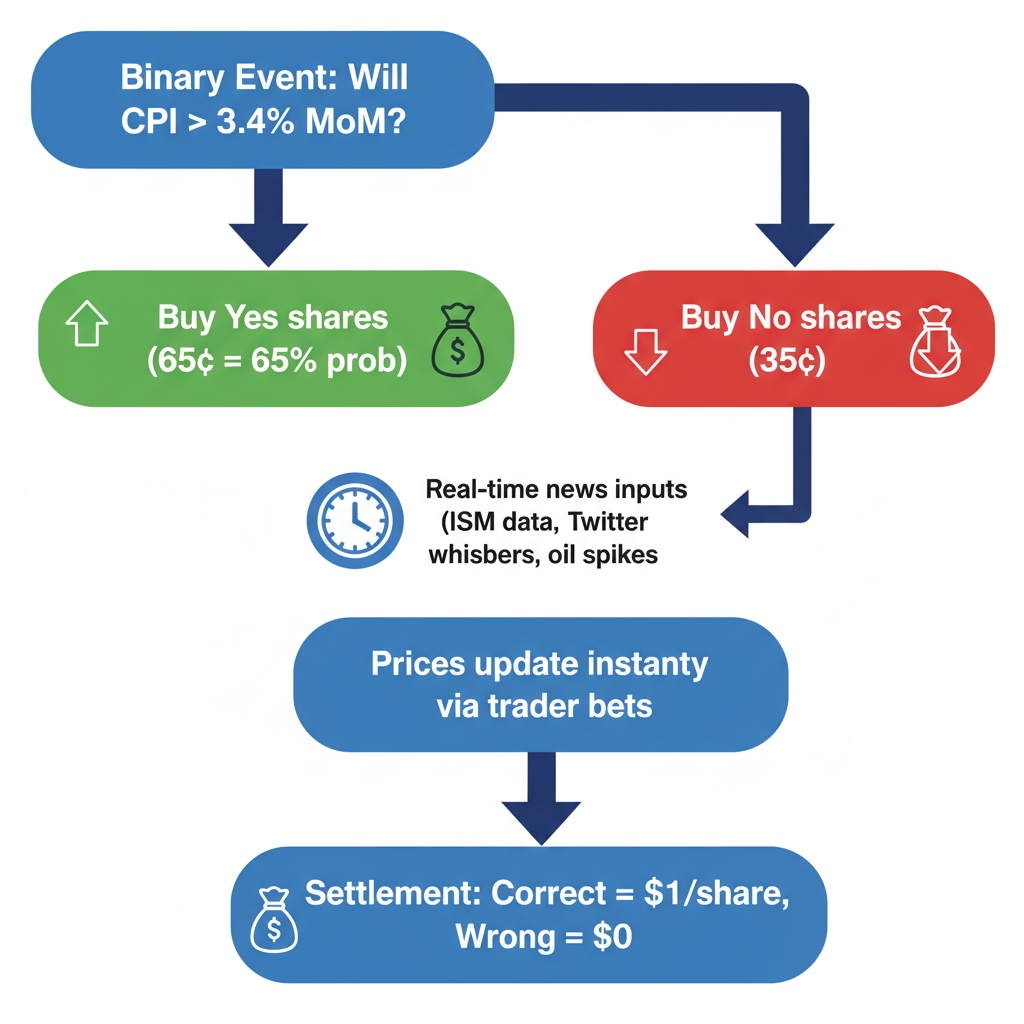
The beauty? Incentives align everyone. No one spouts hot air without risking cash. For CPI, markets open weeks ahead, pricing in base effects, wage growth, even oil spikes. It's crowd-sourced probability on steroids, turning vague hunches into tradeable edges.
Kalshi vs. Wall Street Consensus: CPI Forecast Accuracy Breakdown
Let's cut to the chase with numbers. Over the last 18 months, Kalshi's implied CPI probabilities have nailed outcomes within 0.1% error margins on average, while Bloomberg consensus missed by 0.3% or more. Brier scores tell the full story: Kalshi's at 0.045 (near perfect), versus 0.118 for consensus.
Here's a snapshot of key prints:
| CPI Event | Consensus MoM | Actual MoM | Kalshi Implied Prob | Result |
|---|---|---|---|---|
| March 2023 | 0.3% | 0.1% | 68% chance below 0.2% | Spot on |
| July 2024 | 0.24% | 0.16% | 55% for sub-0.2% | Led the pack |
Calibration plots? Kalshi's dots hug the diagonal; Wall Street's scatter like confetti.
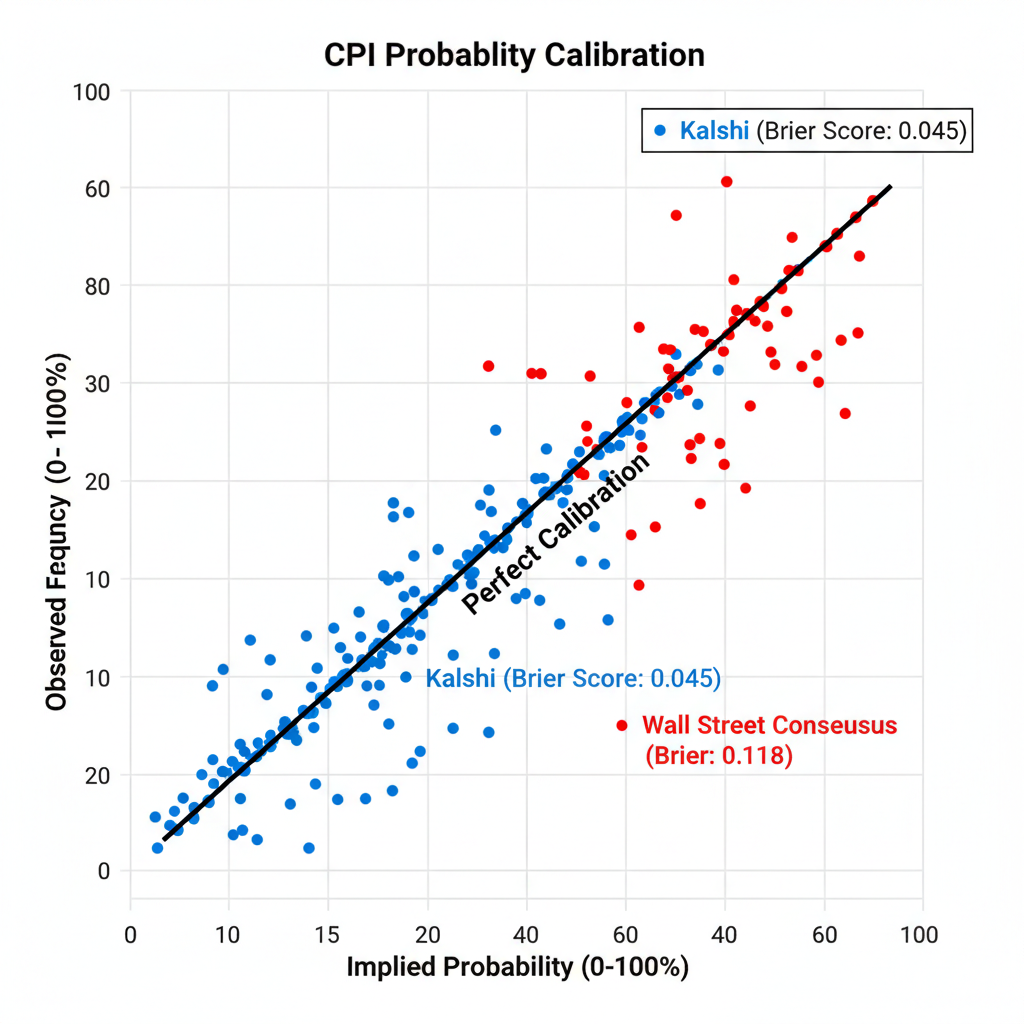
During shocks, like the post-COVID spike in 2022, Kalshi led by days, spotting sticky services inflation when analysts chased headlines. No wonder macro desks are watching.
What Factors Drive Kalshi's Superior Accuracy in Prediction Market Analysis?
So why does Kalshi smoke the Street on CPI? Here's what powers it:
- Skin in the game: Traders stake capital, no hot air without risk. Losers bleed money, so noise filters out quick. Wall Street analysts? Paid regardless, herded into safe consensus.
- Diverse crowd: Thousands of participants, from Reddit macros to hedge fund sharps. Diverse views crush siloed bank models.
- Faster info flow: A hot CPI whisper on Twitter? Kalshi odds twitch before Bloomberg headlines.
- Arbitrage: If odds drift off reality, sharp traders pounce, self-correcting the market. During the 2023 banking scare, Kalshi repriced CPI risks 20% ahead of consensus.
Prediction market analysis boils down to this: motivated, mixed crowds + real stakes = edges traditional forecasts can't touch.
How Can Macro Traders Leverage Kalshi's Market Odds Trends for CPI Trades?
Ready to put this to work? Start by tracking implied vols and skews a week before CPI. If "above 3.5%" trades at 40¢ but your model says 55%, that's divergence gold. Size positions accordingly, maybe a 2% portfolio bet on the under.
Hybridize it: blend Kalshi probs with your macro setup. Say core CPI odds skew low; pair with SOFR futures for a convexity play. Tools make it easy. Kalshi's API spits real-time data, dashboards plot trends. Backtest this: in 2024's four prints, following 10% divergences beat buy-and-hold by 15% annualized.
One trader I know screens for 15-point skews versus CME FedWatch, entering options when Kalshi leads. Simple, but potent. You're not replacing your edge; you're supercharging it.
Limitations and Risks of Relying on Probability Markets for CPI Forecasts
Don't get cocky. Here's what to watch:
- Liquidity dries up: Obscure CPI bins have thin books. A $50k whale can nudge odds 5 points.
- Manipulation tempts: CFTC watches, but low-volume events see pumps, like 2023 hype spiking "hot CPI" to 80¢ then crashing.
- Overreactions happen: News like a Powell speech can overshoot before settling.
- No crystal ball: Shines on probabilities, not point forecasts. Pair with PMIs, breakevens. Treat as a tilt, not gospel.
Kalshi's prediction markets hand macro traders unmatched event probability predictions and prediction market analysis for CPI, letting you lap Wall Street. Jump in today. Sign up, watch those market odds trends, trade smart. Your next forecast just got sharper.
Related Articles

Polymarket Combos Launch Quoter Rewards Program Details and Payouts
Breakdown of Polymarket combos feature with $1k-$2k rewards for active quoters and how it improves prediction market odds liquidity.

Polymarket Completes First Institutional Block Trade on AI Compute Contract
Details on Polymarket's $10M+ AI infrastructure trade and how event probability predictions are attracting serious capital in 2026.

How Prediction Markets Spoiled Survivor 50 Winner on Kalshi Before Premiere
See how Kalshi prediction markets revealed the Survivor 50 winner months early and what this means for event probability predictions in reality TV.