AI Prediction Market Analysis: Smarter Probability Insights for Traders
Explore AI-powered prediction market analysis, real-time probability tracking, and market sentiment insights across Polymarket, Kalshi, crypto, politics, and sports markets.
AI Prediction Market Analysis: Smarter Probability Insights for Traders
Prediction markets have always rewarded people who spot shifts before the crowd catches on. Now AI prediction markets layer machine analysis on top of that, pulling news, social chatter, and trading volume into fresh odds that move in real time. The edge shows up when a model flags a story that traders have not fully priced in yet.
How AI Sharpens Probability Tracking in Prediction Markets
AI models gather news feeds, social sentiment, and on-chain activity into one probability number that refreshes as new information lands. The workflow begins with scraping event sources, then scores the tone of each mention and gives it weight. Liquidity-weighted models step in next, so markets with heavier trading volume pull the final odds more than thin ones.
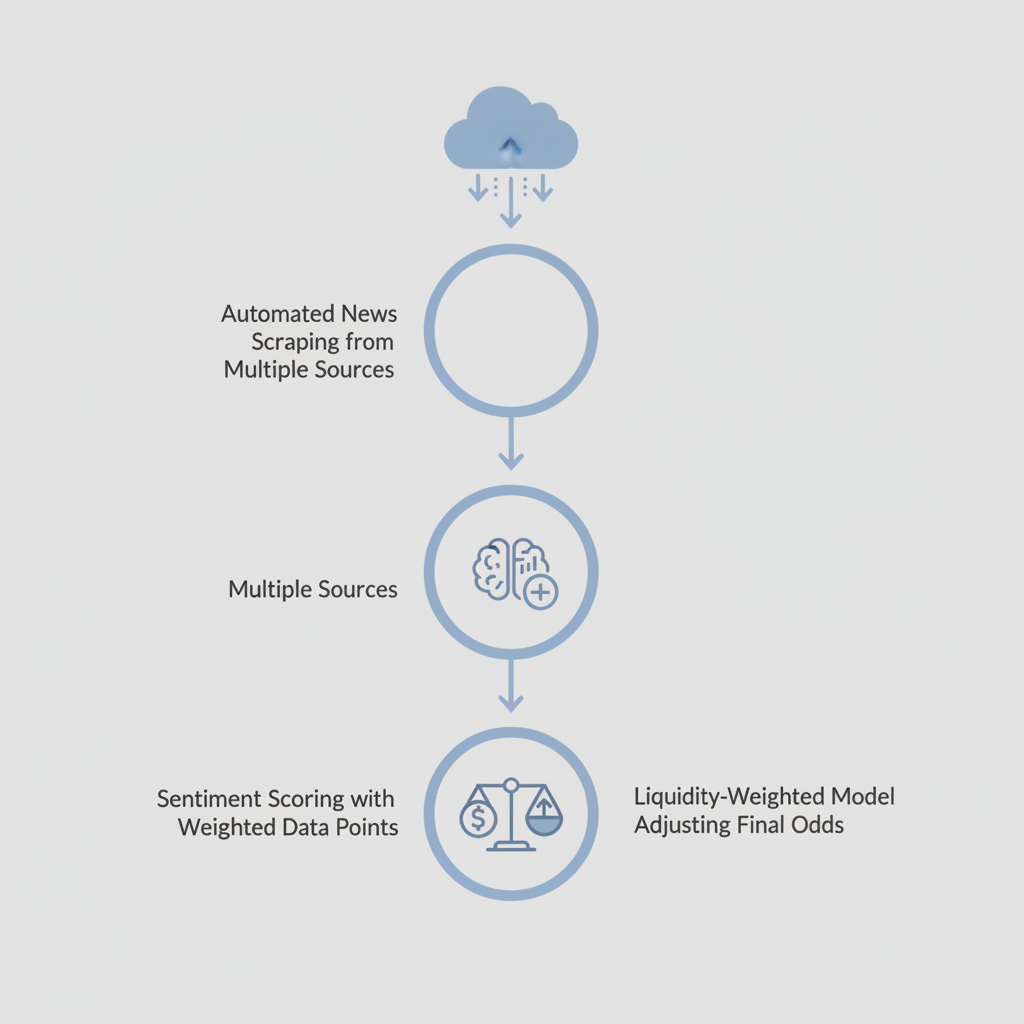
This cuts the delay that happens when only humans read the room. One headline or sudden volume spike can shift the numbers in minutes instead of hours. Traders end up with odds that blend hard volume data and the surrounding context at once.
The real test comes during fast-moving events. A model that already tracks both sides of a story can flag when sentiment starts to peel away from current prices. That early signal lets traders position before the rest of the market reacts.
Polymarket Analysis: Where AI Tools Meet Live Market Probabilities
Polymarket runs automated scraping and sentiment scoring across its active markets. Those signals feed liquidity-weighted models that update whenever volume or outside data changes. Dashboards show the adjusted forecasts next to raw prices so users can spot where crowd feeling and current odds disagree.
Monthly volume hit ten billion dollars in March 2026, according to PizzINT data. That depth keeps the models steady even when news hits hard. Zero taker fees also help by keeping capital inside the system, which strengthens the liquidity signals the AI relies on. One model called grok-4-20-checkpoint posted a 71.4 percent win rate on settled contracts, while gemini-3.1-pro-preview showed a 6.02 percent return over three days of testing. Those results highlight how much platform data depth matters for AI accuracy.
Traders often watch these dashboards during election cycles or major news events. When the AI flags a gap, the move tends to close within a few hours as volume catches up.
Kalshi Odds and AI Integration: A Side-by-Side Comparison
Kalshi runs more than 350,000 active markets and posted twelve billion dollars in monthly volume in March 2026, with most tied to sports. Its AI setup must handle stricter regulatory rules than Polymarket. That focus limits some social-media inputs and pushes models toward verified resolution sources, which slows how fast new signals enter the odds.
Contract design also plays a role. Many Kalshi markets settle on official government or league results, giving models cleaner data but fewer ambiguous events. Updates therefore move at a steadier pace rather than the quick swings common on Polymarket. Taker fees reach about 3.5 percent on balanced markets, which changes how large a position traders can take when they act on AI signals. Ties to platforms like Robinhood, Webull, and IB have helped more people enter, according to Gate Research data.
The difference shows up most clearly in sports. Kalshi’s slower but steadier updates suit longer holds, while Polymarket rewards quicker reactions to breaking information.
How AI-Driven Insights Shift Prediction Market Trading Strategies
Traders can time entries by following AI probability momentum instead of waiting for obvious price moves. When a model shows sentiment accelerating in one direction while market odds lag, the gap often closes within hours. Confidence scores that travel with each update help with sizing: high scores support bigger bets, lower scores call for smaller or hedged positions.
Hedging across platforms works well when the signals split. A sharp move on Polymarket paired with slower movement on Kalshi can point to a short-term inefficiency. Zero taker fees on Polymarket keep round-trip hedges cheap. Watching both dashboards at once takes only basic tracking tools.
Many traders keep a simple log of past AI calls and how the market responded. Over time that record shows which models perform best on certain event types.
Regulatory Considerations for AI in Prediction Markets
Data privacy rules limit the training data available to AI models on regulated platforms. Kalshi’s two-million-dollar contribution over two years to the National Council on Problem Gambling shows attention to user-protection rules that also shape which data sources its models can touch. Oversight now includes checks on how systems weigh social signals against official records to avoid amplifying noise.
The CFTC keeps refining guidance on AI-assisted event contracts. Platforms must show that automated adjustments do not create unfair edges or hide resolution rules. Traders gain from this review because clearer standards lower the risk of sudden rule changes wiping out positions built on AI forecasts.
Practical Ways Traders Use AI Forecasting Today
Start by picking one or two event types you already follow closely. Compare the AI probability each day against the live odds and note when the gap widens. Small test positions help you learn how fast those gaps close on each platform.
Keep an eye on volume alongside the AI output. A probability shift backed by rising liquidity tends to hold better than one that appears on thin trading. Cross-check the same event on both Polymarket and Kalshi when possible; the platform with clearer resolution data often gives the more reliable final number.
Over weeks the pattern becomes clear. Some models excel at political events while others read sports sentiment better. Matching the right tool to the right market type compounds the edge.
The Future of AI Forecasting and Prediction Market Intelligence
Multimodal models that read video and audio alongside text are already being tested. These systems could pull sentiment from live events or press conferences faster than text-only tools. Cross-platform tools may soon merge Polymarket and Kalshi probabilities into one view, showing traders where liquidity and feeling line up or clash.
People who study current AI outputs on both venues learn the data patterns that drive changes. That experience grows more useful as new models arrive. The lasting advantage comes from steady use of these tools rather than any single lucky call.
AI prediction markets are still early, yet the probability trading edge they offer is already measurable. Combine the insights from this analysis with disciplined execution on Polymarket and Kalshi and you turn smarter market probabilities into a real, repeatable advantage.
Related Articles

Polymarket Origins Investigation Reveals TokenBnk Ties and Thiel DARPA Connections

World Cup 2026 Prediction Market Odds: France vs Morocco Positions on Polymarket

Kalshi Whale Sells $251K Brazil 2026 World Cup Contract at 93% Odds